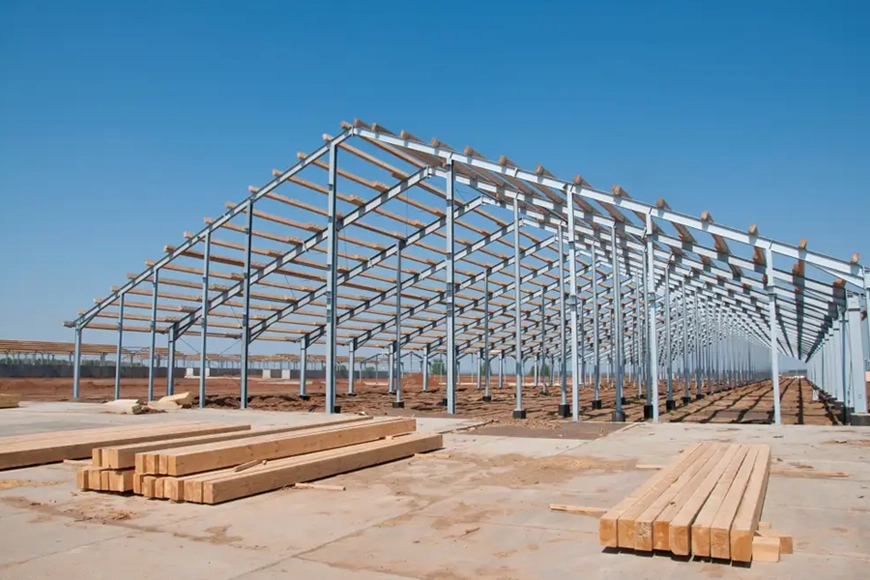
Pre-Engineered Buildings Manufacturer in India
Pre-Engineered Buildings (PEB) are widely used in modern industrial construction because they offer faster project execution, predictable structural performance, and scalable layouts. APM Infratech manufactures Pre-Engineered Buildings across India, supplying structural systems for factories, logistics parks, warehouses, infrastructure facilities, and industrial sheds.
Manufactured using engineered steel components designed for specific project conditions, PEB structures reduce on-site fabrication requirements and streamline installation timelines. From design engineering and fabrication to nationwide dispatch, APM Infratech supports industrial projects across India, helping contractors and developers implement reliable structural solutions for large-span buildings and expansion projects.
What is a Pre-Engineered Building?
A Pre-Engineered Building (PEB) is a steel structural system that is designed, engineered, and manufactured in a factory environment and later assembled on-site. The building components—including primary framing, secondary members, and roof systems—are customized according to project load requirements, building span, and intended industrial use.
Traditional steel structures often require extensive on-site fabrication and adjustments during construction. In contrast, Pre-Engineered Buildings are designed using structural engineering software where load conditions, span requirements, and building dimensions are calculated before manufacturing begins.
The structural members are then fabricated using pre-defined specifications. These components typically include:
-
Primary frames
-
Secondary structural members
-
Roof and wall cladding systems
-
Connection systems
Once transported to the project location, the building is assembled through bolted connections and structural erection processes. This approach improves construction planning, reduces site disruption, and enables faster building completion for industrial facilities.
Applications of Pre-Engineered Buildings
Pre-engineered buildings are widely used in industrial and infrastructure environments where large column-free spaces and predictable structural performance are required.
Industrial Manufacturing Facilities: Manufacturing units require large floor spaces for production lines, equipment placement, and internal logistics movement. PEB structures provide wide spans with minimal internal columns, allowing efficient equipment layout and workflow movement within the plant.
Logistics and Warehousing: Warehousing operations require flexible internal layouts for storage racks, forklifts, and loading docks. Pre-engineered buildings support large open spans and clear heights that accommodate automated storage systems and material handling equipment.
Infrastructure and Utility Buildings: Infrastructure projects such as power plants, water treatment facilities, and infrastructure depots often require durable buildings capable of housing large mechanical systems. PEB structures provide structural stability for such installations.
Aircraft Hangars and Transport Facilities: Airports and transport hubs require buildings with wide spans and large door openings. Pre-engineered buildings are suitable for these applications due to their ability to accommodate large structural spans and heavy roof systems.
Commercial Industrial Sheds: Industrial parks and commercial developers frequently use PEB structures for standardized sheds that can be leased to manufacturing or logistics operators.
Expansion of Existing Industrial Plants: When production capacity increases, companies often need to expand existing facilities. Pre-engineered buildings can be integrated with existing structures with relatively minimal disruption to plant operations.
Industries Using Pre-Engineered Buildings
Pre-engineered buildings are used across multiple sectors where structural efficiency and large enclosed spaces are essential.
Manufacturing Industry: Production plants require large structural spans and high roof clearances for equipment installation and production lines.
Logistics and Warehousing Industry: Distribution centers and storage facilities rely on PEB structures for scalable warehouse construction.
Infrastructure and EPC Projects: Engineering procurement construction contractors use PEB systems for infrastructure facilities such as depots, workshops, and storage units.
Agricultural Processing: Food processing plants and cold storage facilities often utilize steel building systems due to their durability and adaptability.
Automotive and Engineering Sector: Automotive manufacturing plants and assembly facilities require flexible layouts for conveyor systems and manufacturing stations.
Operational Considerations
Several operational factors influence the design and performance of a pre-engineered building.
Environmental Conditions
Industrial buildings must be designed according to regional conditions such as wind loads, seismic activity, and rainfall patterns. Structural engineers incorporate these parameters during design calculations.
Load Requirements
If the building includes overhead cranes, mezzanine floors, or heavy equipment, the structural design must account for additional load conditions.
Compatibility With Industrial Systems
Pre-engineered buildings often integrate with systems such as:
-
Overhead crane rails
-
HVAC installations
-
Material handling equipment
-
Fire protection systems
Installation Environment: Site accessibility, foundation design, and equipment availability influence erection procedures and project timelines.
Customization Options
Pre-engineered buildings are typically customized according to project requirements. Common customization areas include:
Building Dimensions: Span, height, and length can be designed based on the intended operational use.
Structural Load Design: Structures can be engineered to accommodate equipment loads, crane systems, or mezzanine levels.
Roof and Wall Systems: Cladding systems may vary depending on thermal insulation needs, environmental exposure, and aesthetics.
Expansion Provisions: Buildings can be designed with future extensions in mind, allowing structural expansion when production capacity increases.
Manufacturing Capability
APM Infratech manufactures structural steel components for Pre-Engineered Buildings in India using controlled fabrication processes and engineering design methodologies.
Manufacturing typically includes:
-
Structural steel fabrication
-
Precision cutting and forming
-
Welding and assembly
-
Surface finishing and corrosion protection
-
Structural inspection and quality verification
Engineering teams evaluate project drawings, structural loads, and building configurations before fabrication begins. This ensures that each building system is aligned with project requirements.
More information about the company’s engineering background can be found here: APM Infratech
Supply Across India
APM Infratech supplies Pre-Engineered Buildings across India, supporting industrial projects in multiple states.
Logistics typically involves:
-
Coordinated dispatch of structural components
-
Packaging suitable for long-distance transportation
-
Phased delivery aligned with construction schedules
This nationwide supply capability allows project contractors and industrial developers to source PEB structures for projects located across India.
Export Capability
Depending on project requirements and documentation, APM Infratech can support international supply of Pre-Engineered Buildings for infrastructure and industrial developments.
Export projects typically require:
-
Structural documentation
-
Shipping packaging standards
-
Coordination with international logistics providers
How to Choose the Right Pre-Engineered Building
Selecting the correct PEB structure requires evaluation of several engineering and operational factors.
Key Decision Factors
Operational Environment: Industrial plants, warehouses, and infrastructure facilities may require different building configurations.
Structural Span Requirements: Large spans require optimized structural designs to maintain cost efficiency.
Equipment Integration: Buildings that support cranes or heavy machinery require specialized structural reinforcement.
Future Expansion Plans: Industrial developers often plan expansion phases, making modular building design beneficial.
Buyer Checklist
Before requesting quotations, buyers should evaluate:
-
Required building dimensions
-
Intended industrial application
-
Equipment loads inside the building
-
Environmental conditions at the project location
-
Expected project timeline
Procurement Process
The procurement process for pre-engineered buildings typically follows structured steps.
-
Project requirement submission
-
Engineering evaluation and design review
-
Quotation and proposal preparation
-
Finalization of specifications
-
Fabrication scheduling
-
Dispatch and project delivery
APM Infratech provides high-quality Pre-Engineered Building (PEB) solutions for industrial, commercial, and infrastructure projects. Our structures are designed for strength, efficiency, and faster construction timelines.
Contact Us
Contact our team for customized Pre-Engineered Building solutions. We offer expert guidance, project support, and reliable construction services tailored to your requirements.
Phone: +91 98180 53271
Email: info@apminfratech.com
1. Is the building suitable for my industry?
PEB structures are widely used in manufacturing, logistics, and infrastructure sectors due to their flexibility and scalability.
2. Can the structure be customized?
3. What are the delivery timelines?
4. Are installation services available?
5. What maintenance is required?
6. What are the advantages of pre-engineered buildings?
7. Are PEB buildings suitable for warehouses?